
A modern train is no longer a vehicle with a few computers on board. It is a moving network. Passenger Wi-Fi, CCTV streamed to a control center, diagnostics feeding the maintenance depot, ticketing, links to several mobile operators at once: each of them is a door. The question for operators and train builders is no longer whether to lock those doors, but who is responsible for the whole house rather than a single room. That is what end-to-end cybersecurity for the rail ecosystem is about.
From closed boxes to a connected target
For most of the history of rail, onboard electronics lived in closed boxes, and the only link to the ground was a voice radio. That world is gone. Digitalization has put IP networks into every car and connected them, permanently, to the operator’s IT.
The consequences are already visible. In October 2022, DSB trains across Denmark stopped for several hours. The railway itself was not attacked. The incident hit a subcontractor whose application drivers relied on for operational information. The same year, hacktivists claimed to have encrypted the systems of the Belarusian railways with purpose-built ransomware. In March 2025, Ukrzaliznytsia needed 89 hours to restore its online services after a large, targeted attack. ENISA’s first threat landscape for transport named ransomware as the most prominent threat to the sector. And in June 2026, a nationwide GSM-R outage in Germany, with no sign of an attack, showed how a single ageing link can still bring a whole network to a halt.
The risk lives in the seams
Most rail cybersecurity conversations start from a component: a firewall here, a certified switch there, a VPN back to the depot. Each piece passes its own test. Attackers do not respect those boundaries. They move through the seams: between the passenger network and the operational one, between a new train and the older fleet it shares a depot with, between what happens on board and what happens on the ground.
Across rolling stock and connectivity projects in Europe, the Middle East and Africa, what I see most often is not a lack of technology. It is a stack assembled from parts that nobody owns from end to end. Each supplier secures its piece, and the gaps between those pieces belong to no one. Denmark is the textbook case: the weak point was not the train, but a dependency nobody had treated as part of the train.
What “end-to-end” should actually mean
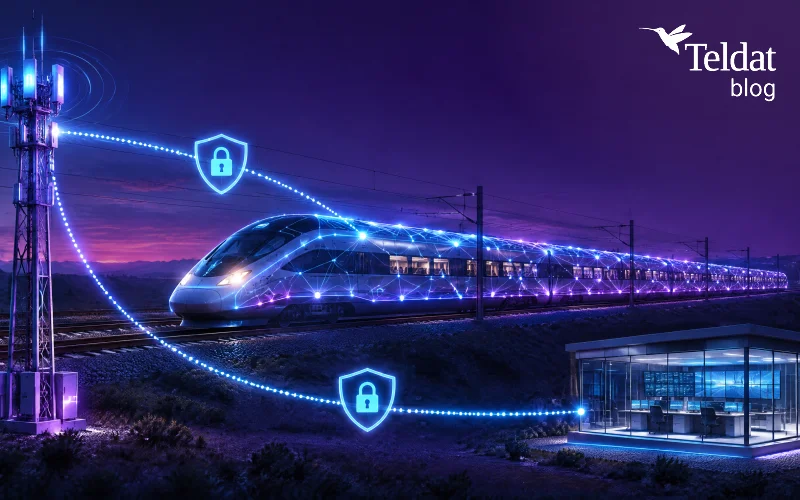
The term is overused, so it is worth being precise. For a railway it means four layers, designed together and run as one:
- On board. Strict separation between passenger, operational and safety-related domains, with traffic control inside the consist and a resilient ring topology, so that losing one car does not cut the train off.
- Train-to-ground. Several bearers and operators aggregated into encrypted tunnels that hold up when one network drops in a cutting or a tunnel. Availability is part of security: a link that fails over badly is a vulnerability.
- Ground. The point where train traffic enters the operator’s systems: zero-trust access, inspection and identity, so that a compromised device on board remains a local problem rather than becoming a network-wide one.
- Operations. Central management, visibility and patching across the fleet’s lifetime. A train runs for thirty years or more. Security that is only true on commissioning day has an expiry date.
The device on the train matters, but it is the console, not the message: what the operator buys is the integrity of the whole chain.
Two fleets, one posture
New trains can be specified with IEC 62443 and CLC/TS 50701 from day one. Most of what runs today was not. Older fleets were built when “onboard network” meant a public address system, and they will stay in service for years to come.
A credible approach treats new and older rolling stock as one estate. Retrofit has to bring older vehicles up to the same posture as the newest ones, without a rebuild and within normal maintenance windows, as in the onboard SD-WAN deployed on the Milan Metro trains. Secure only the new fleet, and an attacker will simply start with the old one.
Regulation is moving the same way
NIS2 lists rail infrastructure managers and railway undertakings among its sectors of high criticality. The Cyber Resilience Act makes cybersecurity a condition of market access for products with digital elements: its vulnerability and incident reporting duties have applied since September 2026, and the rest follows in December 2027. IEC 62443 gives everyone a shared vocabulary of zones, conduits and security levels. The practical effect is the same in every case. Suppliers will be asked to prove security over the life of the product, not only at the delivery inspection. That favors stacks managed and maintained as one system, by a supplier who answers for all of it.
Built for the network that comes next
Rail connectivity is about to change again. FRMCS will progressively replace GSM-R. Satellite links, both LEO constellations and non-terrestrial networks integrated with 5G, are becoming a realistic complement on lines where terrestrial coverage will never be complete. Each transition is also a moment of exposure: new interfaces open, and old assumptions stop holding.
The test I apply to any architecture is simple. Is the next network one configuration away, or one replacement away? The first protects the investment. The second resets both the security case and the budget.
Conclusion
Security in rail is a property of the whole system, and only someone looking at the whole system can guarantee it. That means one design across board, link, ground and operations, one posture for new and older fleets, and an architecture ready for networks that do not exist yet.
At Teldat, we work on exactly this: a single connectivity and cybersecurity stack for rail covering the train, the train-to-ground link, the ground and central management, for new builds and retrofits alike. Nearly two thousand of our onboard units already run in passenger fleets across Europe and the Middle East. To find out how it could work for your fleet, get in touch with our team.