

Cyberthreats are evolving faster than ever, and attackers are becoming increasingly specialized. Not all threat actors operate in the same way. Today’s landscape includes everything from ransomware groups running affiliate-based business models to initial access brokers, state-sponsored actors, insiders, hacktivists, and opportunistic attackers that automate scans for exposed services. This growing diversity means organizations can no longer treat cybersecurity as a collection of disconnected tools. Instead, security needs to be approached as a strategic business capability.
The impact of a cyberattack rarely stays confined to the IT department. A single incident can disrupt operations, affect service availability, compromise sensitive data, create regulatory compliance issues, and damage both customer trust and corporate reputation. As a result, the real question is no longer simply, “Do we have security controls in place?” but rather, “Can our architecture withstand, detect, contain, and recover from a real-world threat?” In modern environments, modular security architectures are built to protect critical data, keep operations running smoothly, and help organizations meet increasingly demanding regulatory requirements.

Understanding Modular Security and Zero Trust Integration
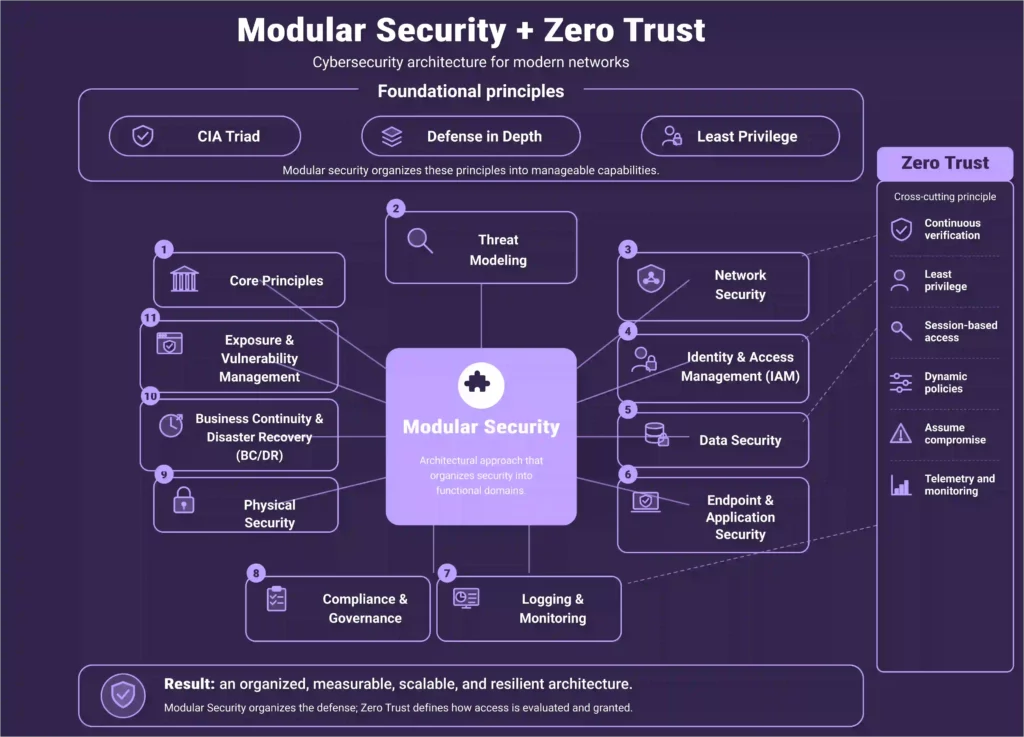
In this context, modular security can be understood as an architectural approach to organizing cybersecurity capabilities into functional domains. It should not be confused with formal frameworks such as NIST CSF, ISO/IEC 27001, CIS Controls, or MITRE ATT&CK. Instead, it offers a practical way to structure security so that principles such as the CIA triad, Defense in Depth, Least Privilege, and Zero Trust can be applied in a consistent, measurable, and sustainable way.
Put simply, modular security does not introduce new principles; it turns them into operational building blocks. Think of it as transforming a rack full of improvised connections into an organized, well-documented infrastructure. The complexity still exists, but it is now supported by governance, visibility, and accountability.
A modular architecture is typically organized into domains such as foundational principles, threat modeling, network security, Identity and Access Management, data security, endpoint and application security, logging and monitoring, compliance and governance, physical security, business continuity, and disaster recovery. Increasingly, organizations are also adding another critical domain: exposure and vulnerability management. This includes asset inventory, attack surface assessment, vulnerability prioritization, secure configuration, penetration testing, remediation, and continuous validation of security controls.
The Advantages of Modular Security and Zero Trust Integration
One of the main advantages of this model is that it reduces complexity without oversimplifying security. Each module can have its own owners, policies, metrics, processes, and specialized tools. IAM can evolve through MFA, SSO, RBAC, and PAM; networks can be strengthened with segmentation, IDS/IPS, and access controls; data can be protected through encryption, classification, DLP, and backups; while endpoints can mature through EDR, patch management, and application controls. Every component within a security architecture serves a specific purpose, and weak implementation or the absence of one of those components can weaken the organization’s overall security posture.
Threat modeling is one of the most strategic areas because it helps organizations avoid designing security purely around intuition or technology trends. Its goal is to identify critical assets, assess threats and vulnerabilities, analyze potential impact, and prioritize mitigation efforts. Methodologies such as STRIDE help evaluate risks related to spoofing, tampering, repudiation, information disclosure, denial of service, and privilege escalation. This approach makes security more proactive and risk-driven.
Network security also remains a core pillar, although it has evolved significantly. Firewalls, IDS/IPS, VPNs, and segmentation still play an important role, but they now need to be designed with a more modern mindset. Segmentation helps limit lateral movement and reduce the impact of a breach. In cloud, hybrid, and distributed environments, this approach naturally extends to microsegmentation and more granular controls. Traditional VPNs are still useful in certain scenarios, but they should not be confused with Zero Trust. A VPN typically provides access to an entire network, whereas a ZTNA approach grants access only to a specific application or resource, based on context, continuous verification, and least-privilege principles.
This evolution is also reflected in models such as SASE and SSE, which help organizations apply consistent security policies across remote users, multiple locations, cloud services, and distributed applications. Capabilities such as ZTNA, Secure Web Gateway, CASB, DLP, Firewall as a Service, and secure SD-WAN bring security closer to the user, the data, and the application itself, instead of relying entirely on the traditional network perimeter. The perimeter has not disappeared; it has simply stopped being the center of the security strategy.
Identity and Access Management
Identity and Access Management (IAM) is another key component of modern cybersecurity architectures. In today’s environments, identity has become a central control point. It is no longer enough to know where a connection comes from; organizations also need to understand who is requesting access, from which device, under what security conditions, to which resource, and with what level of risk. Technologies such as MFA, SSO, RBAC, ABAC and PAM help reduce excessive privileges and improve control over elevated permissions. This approach is closely aligned with the principle of least privilege: granting users only the access they need to perform a specific task.
Data security must protect information at rest, in transit, and in use. Encryption, access controls, classification, DLP, masking, and backups all play an essential role. Backups in particular should not be treated as just another operational task, but as a critical safeguard against ransomware, human error, and infrastructure failures. A mature architecture protects data before, during, and after an incident.
Endpoints and Applications
Endpoints and applications also require special attention. Laptops, mobile devices, servers, APIs, and cloud applications are often common entry points for attackers. For this reason, a robust architecture should include EDR, patch management, hardening, vulnerability testing, WAF, RASP where appropriate, code reviews, and secure development practices. In modern environments, especially those based around microservices and APIs, application security can no longer be treated as a final check before production. It needs to be integrated throughout the entire development lifecycle.
All of this depends on a strong layer of observability and response. Logging, monitoring, SIEM, XDR, playbooks, and automation help turn isolated events into actionable intelligence. But having logs does not necessarily mean threats are being detected, and detecting a threat does not always mean it can be contained. In the same way, responding to incidents does not automatically lead to organizational learning. Real maturity comes when organizations can correlate signals across identities, endpoints, networks, cloud environments, applications, and data to contain incidents, refine policies, and continuously strengthen their security posture. Logging provides the traceability needed for forensic analysis, while monitoring helps identify suspicious activity in real time.
Zero Trust Integration
Zero Trust integration fits naturally within a modular security architecture. According to NIST, Zero Trust is built around a set of principles designed to reduce uncertainty in access decisions by applying least-privilege access in environments where the network must always be treated as potentially compromised. A Zero Trust Architecture is not just a technology stack, but a strategic approach that defines how components, workflows, and access policies work together.
In practice, Zero Trust means evaluating every access request dynamically based on factors such as identity, device, application, resource, data sensitivity, location, behavior, and security posture. Its core principles include treating all data and services as resources, securing communications regardless of network location, granting access on a per-session basis, applying dynamic policies, continuously authenticating and authorizing users, monitoring assets, and collecting telemetry to strengthen the organization’s security posture over time.
Migrating towards an Integrated Zero Trust Model
The transition toward an integrated Zero Trust approach should be gradual. NIST describes it as a journey rather than an immediate replacement of existing infrastructure or processes. For some time, many organizations will continue operating in hybrid environments, combining Zero Trust workflows with traditional perimeter-based controls. Before moving forward, organizations need a solid foundation: an inventory of physical and virtual assets, identities, privileges, business processes, traffic flows, and dependency maps. Without that level of visibility, implementing Zero Trust can lead to unnecessary disruptions, permanent exceptions, and operational friction.
For this reason, migration is usually more effective when approached through specific use cases, such as protecting a critical application, strengthening remote access, reducing administrative privileges, segmenting sensitive systems, or improving data protection. Progress should be measured using clear indicators, including MFA coverage, the percentage of inventoried assets, privileged accounts managed through PAM, mean detection and response times, endpoints protected by active EDR, compliance with critical patching, reduction of excessive privileges, critical segments protected by explicit policies, and successful recovery testing.
Finally, business continuity and physical security should not be overlooked. Resilience includes redundancy, recovery capabilities, BC/DR testing, data center protection, physical access control, and monitoring of critical infrastructure. A secure architecture does more than prevent incidents; it also enables organizations to continue operating during a crisis and recover with minimal disruption.
Conclusion
In conclusion, modular security brings structure, while Zero Trust brings greater control and context to access decisions. Observability strengthens detection and response capabilities, and continuous improvement turns all of these elements into real resilience. Modern cybersecurity is no longer about simply accumulating controls. It is about designing an architecture capable of adapting before, during, and after an incident. In cybersecurity, the future is not predicted; it is designed, monitored, and continuously improved before someone else can exploit its weaknesses.