

Teldat’s 5G Standalone FAQ’s
1. What are the core performance advantages of a 5G network?
2. What is the difference between NSA and SA modes in 5G deployment?
3. What is eMBB and how does it improve mobile broadband?
4. How does 5G achieve latency below 1ms?
5. What is Massive IoT and what are its requirements?
6. How does 5G facilitate Fixed Wireless Access (FWA) for enterprises?
7. How can 5G be used as a network resilience for fixed line connectivity?
8. What is “Network Slicing” in a 5G context?
9. How does 5G technology impact the future of connected vehicles (V2X)?
10. What role does 5G play in “Cloud Robotics” and Smart Manufacturing?
11. How does 5G improve healthcare through eHealth?
12. What are the primary security challenges associated with 5G?
13. What is 5G RedCap?
14. What are the benefits of Private 5G networks for organizations?
15. How does 5G Network Slicing offer a dynamic & scalable infrastructure?
1. What are the core performance advantages of a 5G Standalone network?
5G Standalone delivers ultra-low latency, higher reliability, performance, and better efficiency by using a cloud-native 5G core. It enables network slicing, advanced QoS control, and supports real-time, mission-critical and enterprise applications.
2. What is the difference between NSA and SA modes in 5G deployment?
Non-Standalone (NSA) 5G uses a 4G LTE core to deliver faster data speeds quickly and cost-effectively. Standalone (SA) 5G connects directly to a 5G core, enabling ultra-low latency, network slicing, and advanced enterprise and industrial use cases.
3. What is eMBB and how does it improve mobile broadband?
Enhanced Mobile Broadband (eMBB) is a primary 5G technology designed to significantly improve data speeds, capacity, and user experience compared to 4G LTE. It enables high-speed mobile broadband for all types of applications used by companies and organizations.
4. How does 5G achieve latency below 1ms?
Ultra-Reliable Low Latency Communications (URLLC) is the feature responsible for achieving latency of 1ms or less. This requires sophisticated technical implementations such as multi-connectivity, redundancy, and carrier aggregation in radio access, alongside a specialized Quality of Service (QoS) different from standard broadband.
5. What is Massive IoT and what are its requirements?
Massive IoT refers to the interconnection of billions of devices, such as industrial sensors, wearables, and smart city infrastructure. It is driven by scale rather than speed, requiring deep coverage and high density to support numerous devices that often have limited battery life.
Massive IoT refers to the interconnection of multiple devices, such as industrial sensors, wearables, and smart city infrastructure. It is driven by scale rather than speed, requiring deep coverage and high density to support numerous devices that often have limited battery life.
6. How does 5G facilitate Fixed Wireless Access (FWA) for enterprises?
7. How can 5G be used as a network resilience for fixed line connectivity?
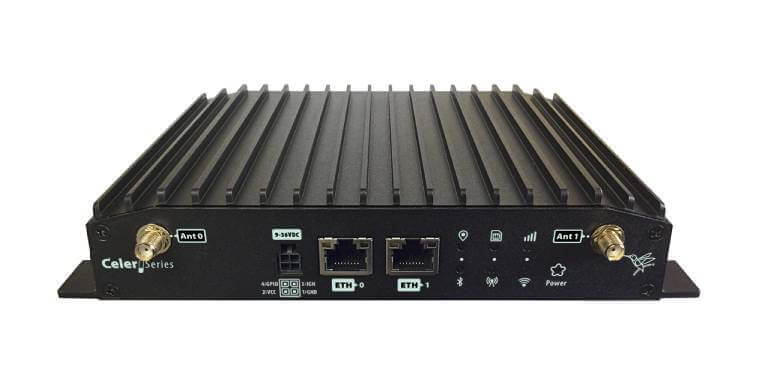
Teldat’s business-grade 5G enabler provides a simple 5G network connection. While being independent of the main router, it seamlessly backs up the enterprise’s existing cable connection to give WAN resilience with 24/7 Internet connectivity and can be up to 10 times faster than 4G LTE.
8. What is “Network Slicing” in a 5G context?
5G network slicing is the key to digital transformation that enables personalized connectivity, security, and service guarantees. The same 5G network can run high speed, low latency, massive IoT connectivity and high bandwidth on the same network by applying slicing.
9. How does 5G technology impact the future of connected vehicles (V2X)?
5G enables Vehicle-to-Everything (V2X) communication, where cars interact with their surroundings. This includes Vehicle-to-Infrastructure (V2I) (traffic lights, parking meters) and Vehicle-to-Vehicle (V2V) (sharing data with other road users). This connectivity is the foundation for fully autonomous driving and safer, more energy-efficient roads.
10. What role does 5G play in “Cloud Robotics” and Smart Manufacturing?
By using 5G and edge cloud routers, robots in manufacturing can be controlled and reprogrammed wirelessly from anywhere. 5G allows these systems to exchange the huge volumes of data required for Machine Learning (ML) and Artificial Intelligence (AI), enabling quick and critical decision-making in next-generation factory environments.
11. How does 5G improve healthcare through eHealth?
5G facilitates the transformation of traditional healthcare into smart hospitals. It supports real-time remote monitoring of vital signs and allows patients to connect with doctors via high-quality real-time video or live chat, which can be critical for patient care in remote areas or during crises.
12. What are the primary security challenges associated with 5G?
5G security challenges include a larger attack surface from massive device connectivity, increased software and virtualization risks, complex network slicing security, and the need to protect data across cloud-based and distributed network architectures.
13. What is 5G RedCap?
5G RedCap (Reduced Capability) is a 5G standard for mid-tier IoT devices, offering lower complexity, power consumption, and lower cost than full 5G, while delivering better performance and latency than LTE for industrial and enterprise use cases.
14. What are the benefits of Private 5G networks for organizations?
A private 5G network provides companies and public institutions with a secure, high-performance infrastructure under their full control. Unlike public networks, a private deployment ensures that communication remains within the organization’s parameters, combining the benefits of 5G with enhanced privacy.
15. How does 5G Network Slicing offer a dynamic & scalable infrastructure?
Based on NFV (Network Functions Virtualization) and SDN (Software-Defined Networking), slices can be created, adjusted, or removed in real time as demand shifts. End-to-end orchestration is the biggest technical challenge and is essential for delivering on the promised SLAs and making all of this feasible.