

Over the past decade, cybersecurity has evolved from a specialized technical field into a core pillar of national resilience and executive responsibility. Today, boards and public administrations worldwide face a simple yet crucial question: Who can we trust to protect the systems that underpin our economies, safeguard our citizens, and uphold our institutional legitimacy?
What we have seen is that Europe has quietly become the most reliable source of cybersecurity trust. And not because of marketing or political messaging, but because Europe has built something that few regions can claim: a model where technology, sovereignty, and democratic values converge into concrete, enforceable protections.
That is why organizations far beyond European borders are increasingly turning to European cybersecurity providers offering high-quality European cybersecurity.
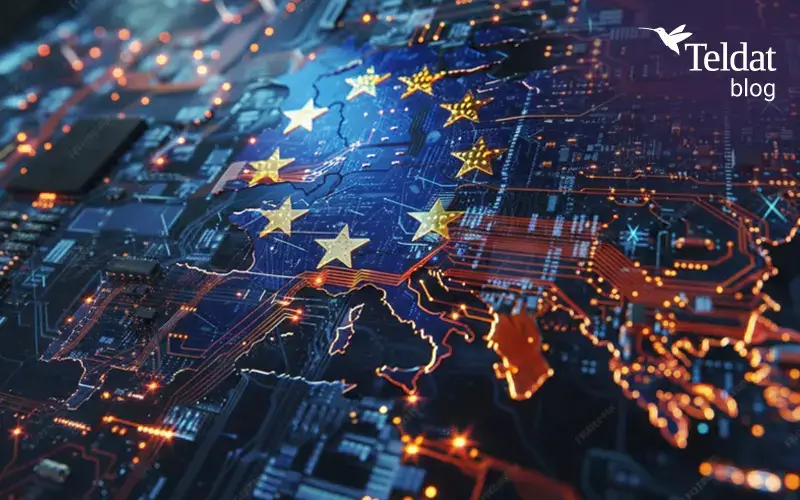
Europe did not demand trust – it builts it
Much of this trust comes from years of hard-learned lessons – often learned the difficult way. The ransomware attack that paralyzed Ireland’s national health service (HSE) for months. The breach that forced Germany’s Anhalt-Bitterfeld district to declare the first ever “cyber disaster” in the country’s history. The SolarWinds supply-chain attack that exposed government agencies across multiple continents. And the countless intrusions that have affected everything from transport networks and energy grids to public services from Scandinavia to southern Europe.
These incidents reshaped Europe’s cybersecurity posture. They made it clear that resilience cannot rely on goodwill or promises; it must be anchored in responsibility, transparency, and independent oversight.
This realization gave rise to frameworks such as GDPR, the NIS2 directive, and the ongoing work of ENISA, which require all technology providers – regardless of size or origin – to operate under auditable, enforceable, and legally binding obligations, backed by real sanctions.
For organizations outside Europe, this matters more than ever. In a global environment where some providers operate under extraterritorial surveillance laws or geopolitical pressure, Europe offers something increasingly rare: predictable rules, democratic governance, and legal certainty.
Data sovereignty is not a European issue – it is a global priority
A common misconception is that concerns about data sovereignty exist only in Europe. In reality, countries across Latin America, the Middle East, and Asia-Pacific are increasingly adopting regulations inspired by GDPR. Why? Because sovereign control over data has become essential for national competitiveness, but also for public trust.
Organizations around the world worry about:
- Providers forced to share data with foreign authorities.
- Infrastructure hosted in jurisdictions with opaque security oversight.
- Supply chains that include components of unknown origin.
- Providers unable to explain how data is accessed, stored, or processed.
European providers are structurally better positioned to respond to these concerns. Our products and services must comply – by design – with the strictest privacy and security requirements in the world. This means that international customers automatically benefit from those same protections.
A multinational bank in Latin America or a ministry in Southeast Asia is protected by GDPR in exactly the same way as any European institution. And in an increasingly tense geopolitical environment, many organizations prefer a partner whose obligations are anchored in European law rather than exposed to the shifting policies of external powers.
Geopolitics has turned technology origin into a strategic decision
Cybersecurity has become inseparable from geopolitics. The war in Ukraine, the rise in disinformation campaigns, and the weaponization of supply chains have forced decision-makers to revisit a simple question: Can we separate where technology is built from the level of security it provides?
Choosing a cybersecurity provider means choosing far more than a technical solution. It means choosing the legal framework, political environment, and intelligence ecosystem that surround that technology. If a provider operates under laws such as the U.S. Patriot Act or the CLOUD Act – or in jurisdictions where state access to data can occur without public oversight – then guaranteeing operational sovereignty becomes impossible.
Europe’s strength lies precisely in its distance from these extremes. The EU does not impose extraterritorial access laws. Its providers are constrained and protected by democratic institutions, independent courts, and transparent governance. For international clients, this matters: Europe offers stable, predictable rules that respect privacy, sovereignty, and legal certainty.
At a time when technology has become a proxy for geopolitical power, this neutrality is a strategic asset.
European providers offer more than regulatory compliance
What often goes unnoticed is that Europe’s regulatory and ethical ecosystem has produced a different kind of cybersecurity provider – one that operates with a higher level of transparency and accountability.
As European companies, we offer:
- R&D, engineering, and after-sales support developed entirely under European jurisdiction.
- Solutions that undergo continuous audits to meet the stringent standards demanded by European public administrations.
- Close collaboration with ministries, critical infrastructure operators, and large corporations that do not accept security compromises.
- Direct access to the teams who design, protect, and maintain the technology.
This proximity builds trust. It eliminates the ambiguity often associated with global providers relying on fragmented or offshore support chains. And it ensures that, in a critical incident, the client is supported by a European partner who shares the same regulatory framework, understands their operational environment, and is bound by the same legal obligations.
This is why an increasing number of organizations far beyond Europe recognize the value of this model. When trust becomes scarce, sovereignty and transparency become strategic advantages.
The reason to choose a European cybersecurity provider like Teldat
The world is moving toward cybersecurity models that prioritize sovereignty, resilience, and accountability. Europe has spent years building the frameworks, institutions, and capabilities that make this possible.
Choosing a European provider is not a regional preference – it is a strategic decision.
It means:
- Your data is protected under the world’s strictest privacy legislation.
- Your provider is shielded from foreign surveillance mandates.
- Your operations depend on sovereign, audited, transparent technology.
- You are partnering with a region where cybersecurity is not treated as a commodity, but as a pillar of democratic integrity and economic resilience.
In a world of growing uncertainty, Europe offers something powerful: a cybersecurity ecosystem built on trust, not on promises.
Choosing a European cybersecurity provider means choosing sovereignty, transparency, and long-term resilience.
At Teldat, we are proud to stand at the forefront of this European model – earning trust through responsibility, proximity, and decades of technological excellence.
In moments like this, trust is essential.