

In critical fleet operations, vehicles aren’t standalone units anymore. Each one is a mobile part of a bigger digital system that relies on continuous, secure, real-time communications. Video streams, telemetry, location data, remote diagnostics, coordination with control centers, and vehicle-to-vehicle / vehicle-to-infrastructure links, only work if connectivity holds up in real conditions. That means scenarios with high speed, patchy coverage, interference, crowded urban areas, and strict uptime demands.
This is why 5G is becoming such a relevant tool for critical fleet operators. The value isn’t just higher speeds; it’s the fact that 5G brings capabilities that older networks could not reliably deliver:
- Ultra-Reliable Low-Latency Communications (URLLC) to support time-critical, mission-focused decisions.
- Advanced V2X (vehicle-to-everything) communications, so vehicles and infrastructure can cooperate for safety and coordination.
- Network slicing with guaranteed QoS, keeping critical services protected from best-effort traffic.
Why 5G is an architectural leap for critical fleets?
1) URLLC: When every millisecond matters
5G includes service profiles designed for ultra-low latency and ultra-high reliability. This turns what used to be “best effort” traffic into guaranteed service: emergency alerts, priority law-enforcement video, remote vehicle assistance, teleoperation of mobile assets, or dispatching in mass-incident scenarios.
2) V2X: Vehicles as cooperative system nodes
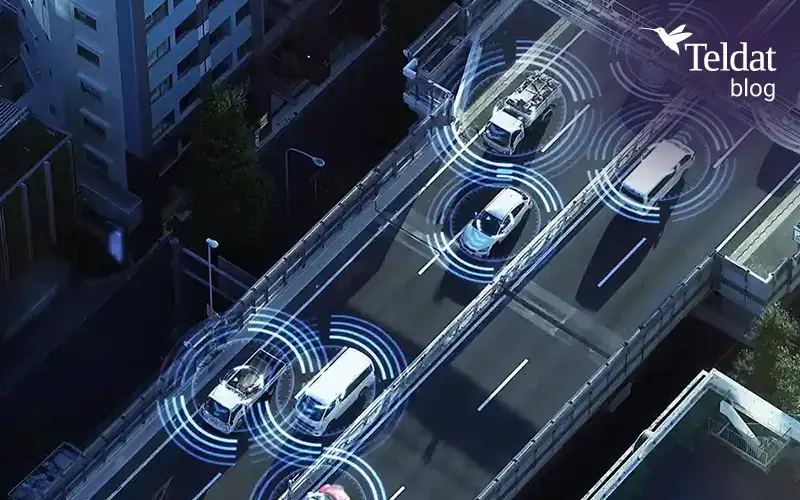
5G NR-V2X improves direct links between vehicles and the road infrastructure around them. Compared with LTE-V2X, it’s built to handle stricter latency and reliability needs, which opens the door to truly cooperative use cases shared situational awareness, assisted driving workflows, convoy/platooning coordination, and live route synchronization. For critical fleets, that translates into improved road safety via early hazard warnings, smart traffic-light priority for emergency vehicles, dynamic coordination between units in motion, with vehicles sharing intent / status in real time and higher resilience even with partial coverage.
3) Network Slicing: keeping the vital separated from the optional
One of the most practical strengths of 5G is network slicing creating multiple virtual networks over the same physical infrastructure. A mission-critical slice can deliver strict latency/reliability guarantees, while passenger Wi-Fi, infotainment, or software downloads run on a separate slice without ever compromising critical operations. This is essential when a single onboard router must support, simultaneously different scenario aspects: HD/4K surveillance video, vehicle telemetry, MCX/critical voice and data, as well as user-facing services (passenger info, ticketing, public Wi-Fi, etc.).
Common critical fleet challenges
Below we will analyze the most common critical fleet challenges and how 5G helps to solve them:
– High mobility and rapidly changing coverage
Critical fleets don’t operate in a “radio lab.” They cross tunnels, rural zones, crowded downtowns, and cell edges constantly. 5G is built for high-mobility performance and optimized handovers, reducing drops and session loss during movement.
– Cybersecurity and segmentation by design
Moreover, critical fleets must isolate domains, which includes operations, passengers, maintenance and emergency traffic. 5G supports native network level segmentation and QoS control, which paired with onboard NGFW/VPN cybersecurity capabilities enables a true “mobile zero trust” posture.
Where 5G makes the biggest difference for critical fleets?
1) Emergency response & public safety
Emergency responders depend on immediate access to information, and this is where 5G’s reliability makes a tangible difference. High-quality vehicle and body-worn camera streams can be transmitted in real time to command centers, giving operators a live view of unfolding situations. Agencies can coordinate more effectively across teams and jurisdictions, even in chaotic or bandwidth-constrained environments. Most importantly, priority routing ensures that critical voice and data always get through, regardless of network congestion.
2) Public transport & urban fleets
Urban mobility systems increasingly rely on continuous connectivity to operate safely and efficiently. With 5G, onboard CCTV and edge analytics can detect anomalies earlier and support faster incident response. Transport operators can deliver real-time passenger information, keep ticketing platforms synchronized, and maintain accurate fleet positioning data. At the infrastructure level, V2I capabilities enable smarter traffic-light management, helping buses and emergency vehicles maintain schedules and reduce delays across busy city corridors.
3) High-value or time-critical logistics
In high-value and time-sensitive logistics, every minute and every data point matters. 5G allows operators to track shipments continuously and maintain a verified digital chain of custody from origin to destination. Routes can adapt dynamically based on changing traffic, weather, or incident conditions. For sensitive cargo, IoT sensors connected over 5G provide immediate insight into temperature, vibration, or tamper events, helping prevent losses and keeping operations aligned with strict service-level expectations.
Conclusions on critical fleet connectivity & cybersecurity
Critical fleets rely on communications that keep working when conditions are at their worst. 5G helps make that possible through URLLC, V2X, and Network slicing, enabling safer, better coordinated, and more automated operations. Still, the radio network is only part of the story. Real performance in the field also depends on the onboard communications platform: solid hardware sizing, a strong cybersecurity stack, and the ability to run multiple services at once without degrading critical traffic.
The approach to mobility must be with that full scenario in mind. Whether they are automotive or railway product lines, they fundamentally require to be built on the same principle: rugged, reliable hardware paired with the latest connectivity technologies, so fleets can trust their communications day after day. The deployed design should be one that considers what actually happens on the road and on the track, even at a high-speed movement. This entails frequent handovers, dense RF environments, long duty cycles, and mixed workloads where mission-critical and non-critical services have to coexist. Moreover, connectivity isn’t enough, if it’s not merged into a cybersecurity solution. These connectivity platforms need to integrate naturally with cybersecurity NGFW and additionally with SD-WAN solutions.
All of this is exactly what Teldat provides its clients. A complete in-vehicle communications offer: secure 5G access, traffic segmentation, policy control, and centralized management. All aligned with the operational reality of critical fleets.